This Week’s Task: Psychologically Nourish Yourself.

For those of you reading our blog for the first time, our personal mandate is to share wellness ideas for everyday living.  In the last month we’ve talked about ways to set goals, commit to a fitness schedule, include your kids in your active life, and improve your nutrition habits.

IMG_0929Today, we want to focus on psychological wellbeing.  We all know that our minds and bodies are intricately connected and that when one feels good, it will influence the other.  And we’ve all had days when our body and mind feel disconnected!  On those days what do you do?

A. Crawl into bed and hope that tomorrow is better.
B. Cry yourself to sleep.
C. Face the demon and madly exercise it away.
D. Ponder the meaning of life.
E. Bitch and complain to your friends.
F. Drink that expensive bottle of wine you’ve been saving.
G. Other: ____________________.

All of the above are valid responses when we’re just not up to our normal zest for life!  Occasionally, we all feel this way; however, if you have more of these ‘down’ days than ‘up’ days, then consider stepping back and reflecting on what’s really going on for you.

What is psychological wellbeing?

IMG_1611Sounds like psycho-babble!  There are as many definitions to psychological wellbeing as there are people in this world.  Just as each of us defines happiness differently, there are different perspectives on psychological wellness. To top that, it is not a static state but rather a moving target.  As we continue to grow, we expect more and different things  from ourselves and from our lives, which affects our wellbeing.

In the field of psychology, experts have also come up with a number of definitions that can help us make sense of this stuff.  For us psychological wellbeing simply relates to feeling excited and energetic about our lives!  Do you feel this way most of the time?  We sure hope so because how you feel about yourself and your life affects you physically and influences your actions.

How do you increase psychological wellbeing?

Experts point to a number of factors that can help us assess our psychological wellbeing and therefore find ways to increase it.  One of the top experts in the field, who also coined the term psychological wellbeing, is Dr. Carol Ryff.  She says the following six dimensions are the foundation for experiencing positive psychological health:

  1. Self-acceptance – Do you have a positive attitude towards yourself?  Do you acknowledge and accept both your good and bad qualities?
  2. Positive Relationships with Others – Do you have warm, trusting relationships with others?  Are you capable of experiencing empathy, affection and intimacy? Do you understand the give and take of human relationships?DSC04258
  3. Autonomy – Are you self-determining and independent?  Are you able to resist social pressures to think and act in certain ways? Can you control your behavior from within?
  4. Environmental Mastery – Can you effectively manage your everyday affairs?  Do you feel in control of your external world?  Do you see opportunities for changing and improving the context around you to benefit your needs?
  5. Purpose in Life – Do you have goals in life and a sense of direction?  Do you feel there is meaning in your life?  Do you have beliefs that give your life purpose?IMG_2220
  6. Personal Growth – Do you feel like you are continually growing?  Are you open to new experiences? Do you see improvement in yourself and your behavior over time?  How well do you know yourself?

(Adapted from table found in Ryff and Keyes, 1995, p. 727)

We can all benefit from reviewing the above dimensions from time to time and asking ourselves where we stand on these.  Reflection is an important part of learning and growing.

IMG_1169“Without reflection, we go blindly on our way, creating more unintended consequences, and failing to achieve anything useful.”

Margaret J. Wheatley  

On a day to day basis, consider doing some of these simple things to enhance your psychological wellbeing:

  • Remind yourself of one thing you like best about yourself.
  • Laugh about one of your shortcomings.
  • Call a good friend or family member who you enjoy talking with.
  • Hug your kids and tell them how much you love them.
  • Put yourself in someone else’s shoes to understand their perspective.
  • Say ‘no’ when you really don’t want to and can’t commit to something.
  • Ask for what you want.
  • Take the lead on a decision that affects you.
  • Make a list of the important things you need to do today and do them.
  • Make wise decisions about what to get involved with.
  • Commit to 20 minutes of “me” time to do what you want.
  • Remind yourself of your most important goal today.
  • Tell your loved ones about your hopes and dreams.
  • Every morning, finish this statement, “Today, I’m excited about…”
  • One day per week, do the opposite of what you might typically do, like be the first to talk at a meeting.
  • Ask for feedback and learn from it.

Tell us what you think by participating in our poll.

We hope you are enjoying our blog and that you have found some good ideas and good recipes that inspire you to live well every day.  If you have, we appreciate your sharing our blog with your friends and family.

References:  Ryff, C., & Keyes, C. (1995). The structure of psychological well-being revisited. Journal of Personality and Social Psychology, 69, 719–727.)

This week’s recipe:  Salmon Cakes

Posted in Weekly Blogs | Tagged , , | 1 Comment

Want to get fit? Make a plan!

When you get to work every day, do you think to yourself, “Hm, what should I do today?”  Not likely!  Otherwise you wouldn’t get much accomplished.  Most of us have a general plan and go about our day getting to the tasks.

IMG_2557Can you say that about your fitness?  Like planning for work or your busy home and family life, fitness needs to be planned to get accomplished.   We admit that some people are better planners than others, and that some people prefer to live spontaneously rather than be constrained by plans.  So for some, planning fitness will be easier.

For uber-planners remember, “You can’t plan for everything or you never get started in the first place.” (Jim Butcher, Changes)  For those resistant to planning, keep in mind that, “Success doesn’t just happen.  It’s planned for.” (Anonymous).  Everything in moderation applies in both cases, unless you have a challenging fitness goal that requires ultra focus and discipline.  For example, preparing to compete in an Ironman while living a ‘normal’ life will take super planning!IMG_2559

Yes, best plans can be laid but not executed or can go astray.  Is that what you’re thinking?  Well, your plan is just the start.  To achieve success you also need to develop the discipline to follow through.  You can create that discipline by forming good habits that make it second nature for you to engage in your fitness activities.  Like your morning routine that you follow every day without thinking about it – getting out of bed, showering, getting dressed, or whatever it is – your fitness routine can become a habit that you just follow.  Figure out your plan and then try to carry it out for at least a month.  Need more convincing or help on how to form good habits?  Check out Charles Duhigg’s book, The Power of Habit: Why we do what we do in Life and Business.

What is a fitness plan?

We’ve convinced you that you need a fitness plan.  Now what?  What does a plan look like?  It depends on your goals!  If you missed it, we talked about goal setting in a previous blog https://aspireperspirenourish.com/2013/03/28/goals-time-to-rethink-yours/.  You can also get more inspiration and direction about goal setting by checking out Lululemon’s site at http://www.lululemon.com/education/goalsetting.

Once you have a sense of what you hope to achieve, consider your current level of fitness and commitment.  Are you just getting started with fitness and can only commit 3 days per week?  Were you active but have fallen off the wagon lately and want to get back at it?  Are you ready to step it up and commit 6 days per week to fitness?  At this point, we recommend that you find a reputable fitness trainer to help you develop a plan (and see your doctor before exercising).  In particular, if you are thinking about a specific fitness or sports goal, like running a marathon, we recommend that you get the help of a professional trainer.  We have worked with some good trainers who we gladly recommend on our Resources & Links page.

Please note that we are not fitness trainers so the sample plans below should not be construed as professional advice.  The plans are examples of what has worked for us!

With the above disclaimer out of the way, the basic components of a plan include a combination of cardiovascular training, weight/strength training, stretching/core and REST.  For those of you new to exercise, here is a brief explanation of each component:

1.  Cardiovascular training IMG_2346

  • The objective is to improve your heart and lung capacity.
  • Cardio includes many forms of exercise that require different levels of physical exertion, e.g. walking, running, swimming, cycling, and so forth.  The lower the exertion level, the longer it can be sustained.  However, the level of exertion can vary by individual based on their level of fitness.
  • Ideally, you want to make it easier to perform the activity so you can gradually move to more challenging activities or a higher exertion level.
  • For a simple way of gauging how hard you are working during an activity, you can refer to The Borg Rating of Perceived Exertion Scale (Borg RPE) http://physicalactivityline.com/pdf_files/pal-doc-perceivedexertionscale.pdf.

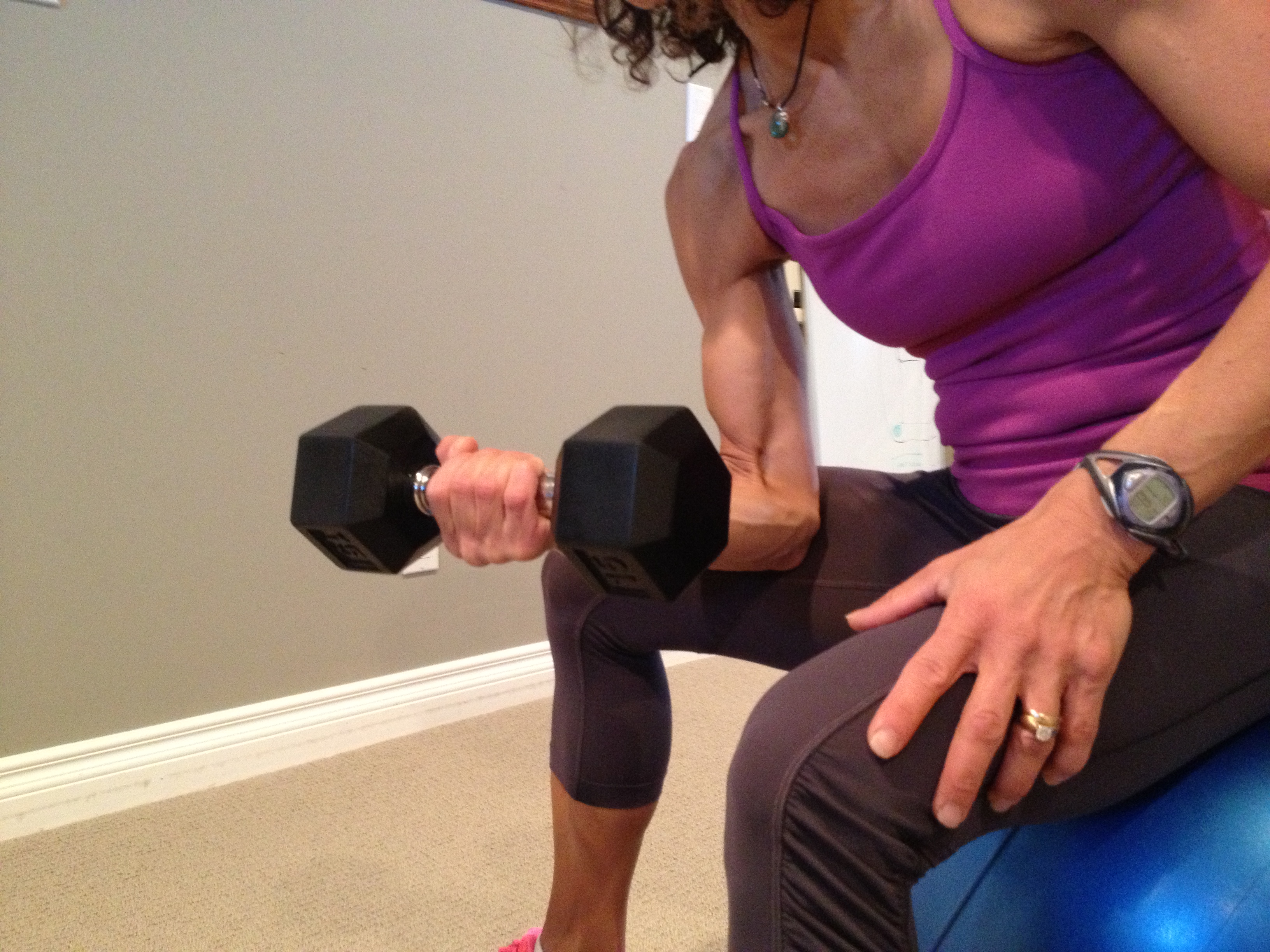
2.  Weight/Strength TrainingIMG_2546

  • The objective is to build your strength, speed, power, and muscle mass.  This training will help define your muscles.
  • When lifting weights or performing strength exercises, be sure to perform them to fatigue to achieve the desired results.  To avoid injury, get advice from a trainer on how to properly lift weights and on how heavy the weights should be to accomplish your goals.
  • A trainer can also recommend a variety of approaches to sequencing the exercises for maximum effect.
  • When doing weight training, focus on all parts of your body not just what you think is your problem area.  There is no such thing as ‘spot’ reduction of problem areas!  Some people like to work different muscle areas on different days, e.g. legs on one day, upper body the next.

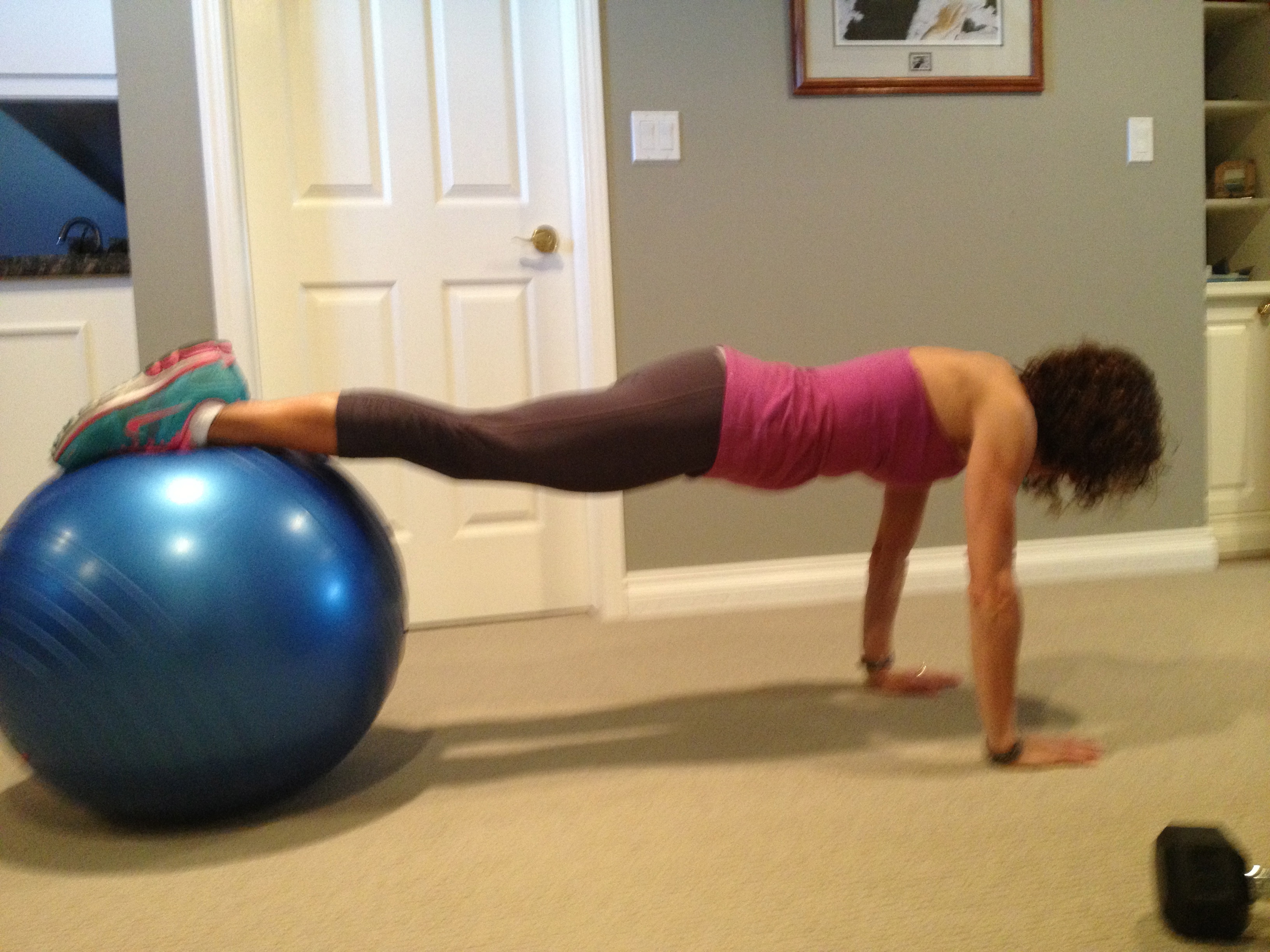
3.  Stretching/CoreIMG_2547

  • Stretching is critical to increase flexibility and a muscle’s range of motion.  It helps to reduce injuries and increase performance.  You should stretch after every workout – even if it is for 10 minutes.
  • The objective of working the core is to strengthen the muscles that stabilize the spine and pelvis.  These muscles run the entire length of the torso.  Abdominal exercises like sit ups are traditionally considered ‘core’ but there is so much more to improving core strength.  Other forms could include planks, push ups, squats, back bridges, lunges and so forth.
  • Yoga can also be very beneficial for stretching and for strengthening the core.  There are many forms of yoga so read about the class before you attend.  Some types of yoga are more strenuous than others.

4.  RestIMG_2386

  • Build in rest days or easier days in your fitness week.  Your muscles need to recover and they get the best benefit from training on the day of rest.
  • Whether you are just starting out or have been active for a while, it is easy to become overtrained.  Look out for the signs of overtraining http://www.exrx.net/ExInfo/Overtraining.html.  Be sure to get proper rest and build up your fitness over time.

Sample Weekly Fitness Plans

So, now you’re thinking, “How do I fit this all into my week?”  Some of us have more time than others!  Do what you can with the time you have available.  The important message is that you need to commit to a plan that will work for you so that you will follow through and stick with it.

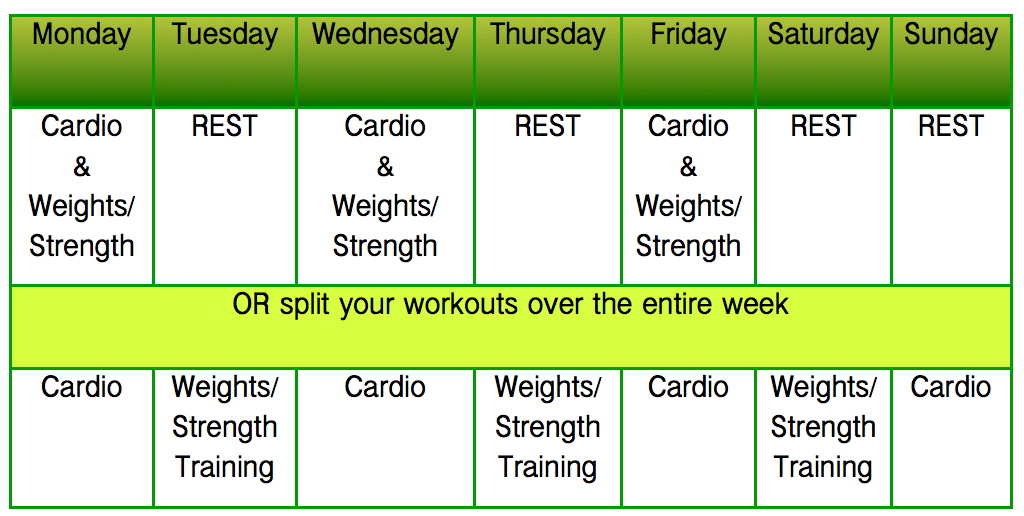
For those of you who are new to exercise, we would suggest that you consider starting by exercising 3 times per week – 30 minutes of cardio plus 30 minutes of weight/strength training.  Incorporate the stretching after each session.  For example:

Basic Sample Fitness Plan.001

New to Fitness? Sample Fitness Plan

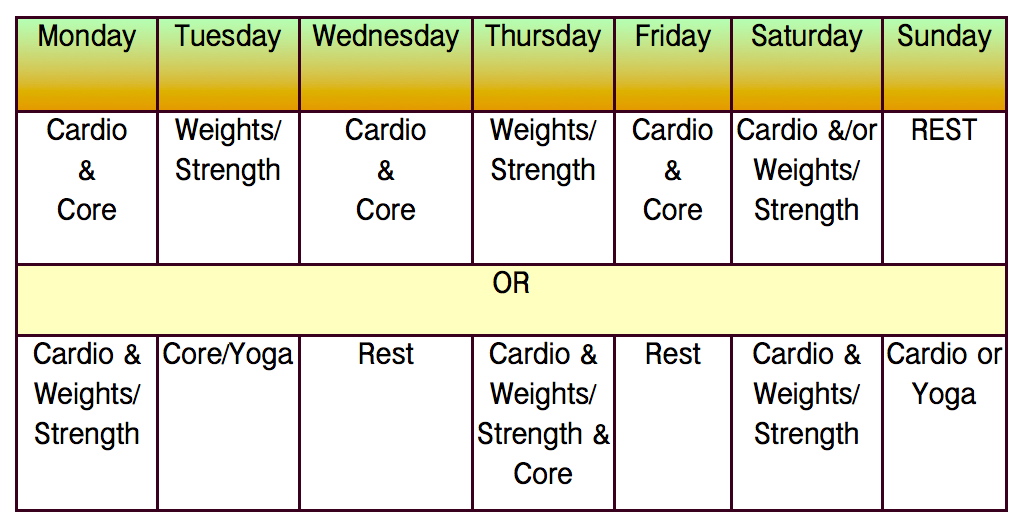
Below are two other simple examples of plans for others who are currently active and want to incorporate more activity into their week.  The plans do not include specifics about the types of exercises you should perform, the length of time to dedicate to each or at what time of day you should exercise.  You can choose to be more specific or just leave it general.  However, we find that the more specific we are with our weekly plan, the more likely we are to complete it.

Typically, we decide at the beginning of each week what we will do each day.  For example, if Monday is a run day, we decide how far we will run or whether it will be a day to train for speed.  Remember to include at least 10 minutes of stretching after each workout.

Advanced Sample Fitness Plan.002

Time to Step up Your Fitness? Sample Fitness Plan

Key Considerations:

  • Determine how many days and how much time you can dedicate to fitness.
  • Determine the number of different workouts you can perform, e.g. 3-4 cardio workouts per week, 2-3 weight/strength training, 2-3 core training.
  • Spread out the different types of activities throughout the week leaving one day between the same type of activity.  For example, do weight training every other day.
  • Some people prefer to do cardio workouts every day.  If so, be sure to make some cardio days easier than others.
  • Cross-train by doing different cardio activities through the week, for example walking, swimming and cycling.
  • Pick your rest day for the week and then build the other fitness days around that.
  • Choose the time of day you will exercise.  You may decide to break out your workouts throughout the day.  For instance, we often do our weight training in the morning before our family is up and ready for the day.  Later, we can do our cardio training, attend a yoga class or do a core workout.  Stay flexible so you can change the timing around based on your schedule.

Professional Help

As we mentioned earlier, we are not professional trainers.  Please be sure to find a reputable trainer to help you achieve your goals safely and effectively.  If you belong to a fitness centre or gym, check with the staff there to find out more about the trainers who work at the facility or who are associated with the gym.

We have added a page to our blog that you can visit for Resources & Links.  We will continue to add and update the page to provide you with information about trainers we have worked with and can recommend.  We will also include links to our favourite yoga studios, magazines, blogs, and videos.

Now, it’s your move! 

“Have a dream, make a plan, go for it.  You’ll get there, I promise.” (Zoe Koplowitz, marathon runner who is afflicted with MS and diabetes)

Recipe of the Week:  Grilled Beef Skewers

Posted in Weekly Blogs | Tagged , , , , , , , , , | 4 Comments